
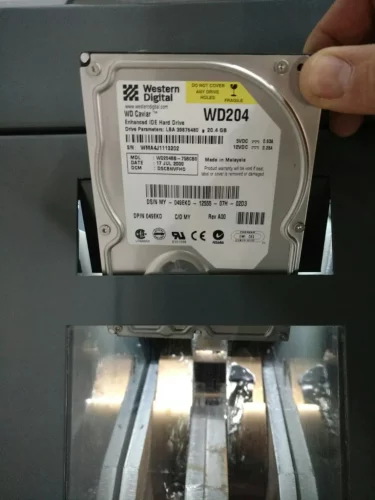
Retiring old computers, servers, and storage devices is more than an equipment-clearing task. A reliable disposal process helps protect sensitive information, document what happened to each asset, and keep electronics in responsible recycling channels.
The right provider should be able to explain its process clearly, from collection through destruction and final disposition. Before you hire, use these 10 checks to compare hard drive shredding services and choose a process that fits your organization’s requirements.
1. Confirm the service covers your media
Start with an inventory. Include hard disk drives from desktops, laptops, and servers, as well as solid-state drives (SSDs), removable media, and other devices that may store data.
Ask the provider which media types it accepts and how each one is handled. HDDs and SSDs use different storage technologies, so don’t assume that a process suitable for one automatically suits the other. Include failed, damaged, or unidentified drives in your questions, too.
A well-defined scope helps prevent devices from being overlooked. E-Waste Central describes shredding services for several drive types and sizes on its hard drive shredding page.
2. Understand what “shredding” means in practice
Ask the provider to explain the destruction method in plain language. Does it physically shred the drive? What happens to its data-bearing components? How does the provider confirm the drive is no longer usable for storage?
NIST’s Guidelines for Media Sanitization explain that sanitization should be selected based on the media and the sensitivity of the information. Physical destruction is one option; it is not interchangeable with every type of erasure or wiping process. If your policy requires physical destruction, get that requirement in writing and confirm the provider will follow it.
For E-Waste Central’s process and equipment details, see hard drive shredding services.
3. Decide whether destruction should happen on-site
On-site shredding allows your staff to observe the process at your location. Off-site service may be convenient for larger collections, but it makes the transport and interim custody process especially important.
Ask where the drives will be destroyed, who will transport them, and what safeguards apply between pickup and destruction. If witnessing the process is important to your security policy, confirm that the provider can accommodate it before booking.
E-Waste Central offers mobile on-site hard drive shredding and describes the service as taking place at the customer’s location. Compare that option with your organization’s operational needs, access rules, and schedule.

4. Review the chain-of-custody process
A secure process should account for media from the moment it leaves your control until destruction is complete. Ask how the provider handles pickup, transport, storage, and any transfers to subcontractors or downstream facilities.
Look for clear answers about who has custody at each stage, how items are protected in transit, and how exceptions or security incidents are reported. NIST emphasizes the importance of tracking media through the sanitization process. A destruction record is useful, but it is stronger when it can be connected to a documented custody process.
E-Waste Central’s data destruction page describes its approach to custody and handling. Ask any prospective provider to explain its own process and provide details relevant to your organization.
5. Ask how each drive will be identified and reconciled
A batch count alone may not be enough for an organization that needs asset-level records. Ask whether the provider can record serial numbers or other identifiers and how it will handle drives with unreadable or missing labels.
Before pickup, prepare a list of the media you expect to hand over. After service, compare that list with the provider’s receipt and destruction records. Resolve any missing, duplicate, or unmatched entries before closing the asset-disposal record.
For municipalities and larger organizations, this step can help connect disposal records to internal asset registers, procurement documentation, and audit processes.
6. Check what the certificate of destruction documents
Ask for a sample certificate before hiring the provider. Confirm that it clearly states what service was completed and whether it identifies the drives by serial number or another unique identifier. Also ask when the certificate will be delivered and how it will be shared.
A certificate is an important record, but it does not replace your inventory or chain-of-custody documentation. Make sure the certificate’s detail matches your retention and audit needs. E-Waste Central’s certificate of destruction page explains how to request its documentation. Its mobile shredding page describes a serialized certificate as available for that service.
7. Clarify how completion is verified
Ask how the provider confirms that the correct devices entered the destruction process and that the agreed service was completed. Depending on your requirements, verification may include witnessing the process, checking records against an asset list, or reviewing a completed certificate and supporting documentation.
Agree in advance on how discrepancies will be handled. For example, determine whom to contact if a serial number is missing from the certificate or an item cannot be processed as planned.
The goal is a process you can explain and document, not simply a general assurance that the drives were destroyed.
8. Address HIPAA and other data-handling obligations
If your organization handles protected health information, include your privacy and security personnel in vendor selection. HIPAA requires covered entities to have appropriate safeguards for the final disposition of electronic protected health information and the media on which it is stored. HHS also explains that a covered entity may hire a vendor to dispose of protected health information, subject to applicable safeguards and agreements.
Whether a provider is a business associate and whether a Business Associate Agreement is needed depend on the specific relationship and work performed. Confirm the requirements with your privacy officer or counsel rather than treating a service label as proof of compliance. Review HHS guidance on disposal by a business associate and disposing of or reusing electronic media.
E-Waste Central provides information about its healthcare-related services on its HIPAA compliance page. Discuss your specific requirements with the provider before scheduling.
9. Ask where the material goes after destruction
Physical destruction addresses the data-bearing device, but your organization should also understand how the resulting material is handled. Ask whether the provider recycles the material, whether downstream processors are involved, and how it prevents media from being diverted before destruction is complete.
The U.S. Environmental Protection Agency recommends that businesses and governments consider certified electronics recyclers. EPA identifies R2 and e-Stewards as certification standards that assess environmental, worker-health, and security practices. Certification can be a useful part of vendor evaluation; it does not replace your need to verify the specific destruction, documentation, and custody requirements in your contract. See the EPA’s guide to certified electronics recyclers.

10. Confirm the full scope, cost, and logistics
Before you book, ask what is included: pickup, containers or preparation instructions, on-site or off-site processing, certificates, and recycling. Confirm service availability for your location, the accepted equipment, scheduling lead time, and any conditions that could affect the work.
Clear terms help prevent surprises and make coordination easier for facilities, IT, procurement, and records-management teams. E-Waste Central’s pickup page states that pickup and its listed services are provided at no charge. Confirm the service scope and applicable arrangements when you request service.

Make your selection with a documented checklist
The best provider is one that can explain the destruction method, account for the media, document completion, and describe how materials are handled afterward. Before approving a vendor, compare its written answers with your organization’s security, compliance, procurement, and environmental requirements.
Prepare your inventory, identify the service you need, and request the documentation in advance. For details about E-Waste Central’s services, visit our pages on hard drive shredding, data destruction, and free pickup.